


The November elections are now behind us, and many people may be disappointed with the results, while others may be happy. Nothing stirs up human passions quite like the three topics—commonly known as the “table topics”—that should not be discussed: religion, politics, and sports. The underlying reason for this piece of folk wisdom is that, generally speaking, everyone claims to be right; therefore, to avoid conflict, the recommendation is that everyone stick to their own beliefs. The saying by the philosopher Wittgenstein applies very well here: “Whereof one cannot speak, thereof one must be silent.”
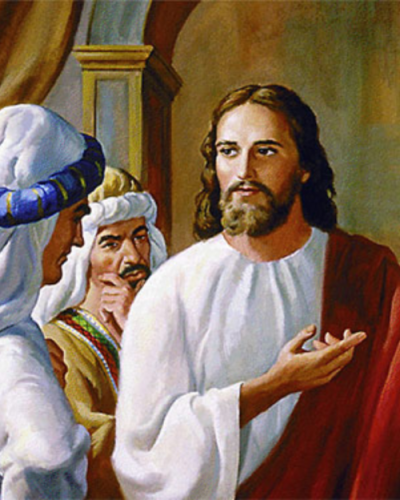
Jesus faced a situation in which it seemed he could say nothing, but he spoke up (Matthew 22:15–22). In Jesus’s time, his people were not free; they lived under the oppression of the Roman Empire. Two groups that hated each other joined forces to set a trap for Jesus: the Pharisees, a religious faction, and the Herodians, a political faction. The Pharisees were nationalists, secretly hostile to Roman rule; the Herodians, on the other hand, were collaborators and supported that rule. Together, they devised a cunning strategy to get rid of Jesus.
“Teacher, we know that you are sincere, that you teach the way of God in accordance with the truth, and that you are not swayed by anyone, for you do not show favoritism.” What false admiration! They praised Jesus’ intelligence and wisdom, assuming he wouldn’t know how to respond. They wanted to make a fool of him. So, they asked him:

“Tell us, then, what do you think: Is it lawful to pay taxes to the emperor, or not?” It was a difficult question to answer. Any answer would be counterproductive, since it would place him either against Rome or against his own nation, Israel.
If Jesus answered, “Yes, it is lawful to pay the tax,” he would be siding with the foreign occupiers and would face rejection from his own people, who were burdened by high taxes. If, on the other hand, he answered, “No, it is not lawful to pay the tax,” the Herodians could accuse him before the Roman prefect, Pilate, of inciting rebellion and opposing the emperor, leading to his imprisonment and trial—often ending in his death.
Jesus asks them for one of the coins used to pay taxes. The denarius, in common use, was a coin issued by the Roman emperor Tiberius. On its obverse—the main side of the coin—appears the head of Tiberius, who was considered a divine being. It represented the perfect blend of divinity and politics. By responding, “Give, then, to Caesar what is Caesar’s, and to God what is God’s,” Jesus strips the Roman government of its divine character and makes it clear that the Kingdom of God transcends the human powers that claim to act in God’s name. At no point does he oppose political power, but he makes it clear that his kingdom goes beyond such aspirations or theocracies. Nothing and no one can replace God: not any government, nor charismatic or populist leaders.
Our duty is to continue defending justice at all times, because where there is justice, there is love. And that is the greatest tribute we can pay to God.
_________
Rev. Israel Portilla-Gómez (He/him/his) is Associate Rector at St. Mary’s Episcopal Church. 2222 E Tudor Rd, Anchorage, AK 99507. Israel@GodsView.org. (907) 563-3341. Ext. 13.
