


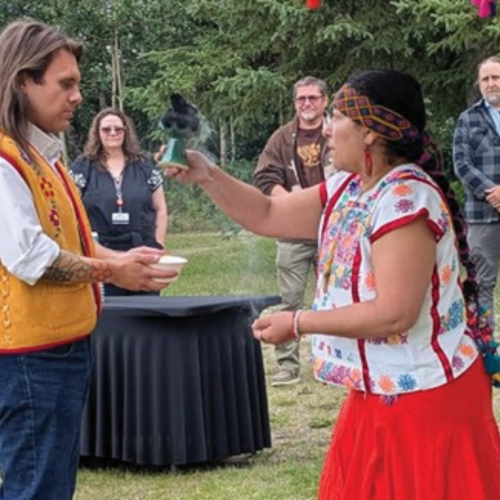
In late July, Itzel Zagal guided a spiritual care ceremony for sacred Mesoamerican pieces at the University of Alaska Fairbanks (UAF) Museum of the North. Itzel is part of the university’s cohort of Mellon Troth Yeddha doctoral fellows.
“This is the first time in 80 years that they have left the museum archives to undergo a ceremony. There are several deities: one is Xipe Totec, associated with agricultural renewal; Grandfather Fire, Huehueteotl, associated with wisdom; and others associated with fertility.”
Itzel, who is also a traditional sahumadora (ceremonial smudger), was joined by friends and fellow members of various Indigenous communities from Alaska and Montana, as well as members of the Fairbanks Latino community.

“We offered mole with morel mushrooms, tortillas, tea, fruit, and flowers. I used copal smoke to smudge the offering and the sacred pieces. Songs and prayers were offered by the participants. I feel very grateful to the Museum of the North and to my professors and mentors for supporting our cultural practices.”
Zagal notes that the ceremony allows us to reconnect with our ancestors and their teachings. “It is also an opportunity to get to know one another and share the offering as a community.”
Four years ago, Zagal studied the Museum of the North’s Mesoamerican collection. “I realized there was the need for context and information.” “With the museum’s support, I took photos of nearly 130 objects to my hometown in the State of Mexico and to Morelos, and there was a sharing of knowledge between communities for Alaska,” she said.
Most of these pieces belong to cultures from Mexico, and this led to the creation of the book “Roots: Indigenous Mexico in Alaska” written by Itzel Zagal, Michelle Lara, Alejandro López, and Gerardo Páez. The Museum of the North published two free editions for communities in Mexico and Alaska. Additionally, the book is available in digital format.
“The book is written in Spanish, English, and Nahuatl (a Mesoamerican indigenous language) to make it accessible to all interested communities,” she said.
Itzel is a lawyer specializing in international human rights law. She lives in Anchorage with her husband and son.
